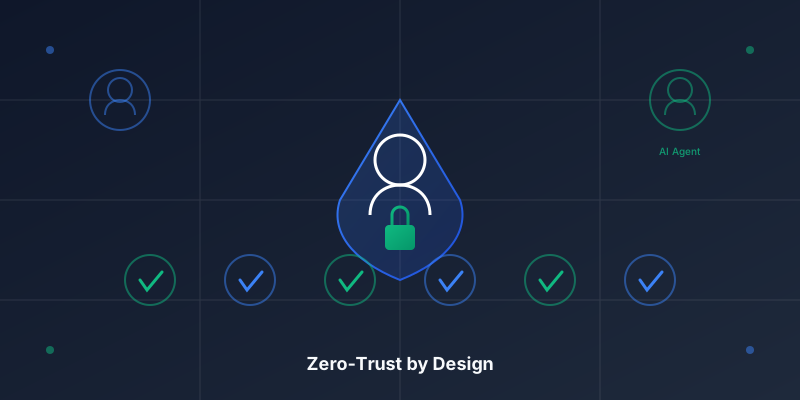
Modern SaaS no longer runs in a world where a perimeter, a VPN, and a role table are enough. Identity has become the new perimeter, and zero-trust is now an architectural property, not a checkbox feature.
Designing with this mindset from day one is the difference between a platform that can safely host AI agents, external workflows, and complex customer tenants — and a legacy monolith that constantly fights privilege sprawl and lateral movement.
Why identity-first matters in 2024–2026
Several converging trends make identity-first, zero-trust architectures non-optional for modern SaaS:
- Remote and hybrid work mean “inside the network” no longer exists as a security boundary.
- SaaS ecosystems integrate dozens of third-party apps, each with their own tokens, secrets, and service accounts.
- AI agents and non-human identities are exploding in number, often with far more power than typical human users.
Zero-trust reframes the system: every request is authenticated, every action is authorized in context, and every identity (human or agent) has strictly bounded blast radius.
Core principles of zero-trust SaaS
At architecture level, zero-trust is primarily about how you treat identities, context, and policy:
- Never trust, always verify: Each request is evaluated; network location is irrelevant.
- Identity as the primary perimeter: IAM, not IP ranges or subnets, decide what happens.
- Least privilege and just-in-time access: Permissions are tightly scoped and short-lived.
- Assume breach: Design as if an access token or agent will eventually be compromised.
In a SaaS platform, these principles shape how you build your control plane, data plane, and observability stack.
Typical SaaS planes in a zero-trust world
- Control plane: API gateway, authentication, authorization services, policy engine, configuration, and admin UI.
- Data plane: Microservices, storage systems, message brokers, and background workers, all enforcing identity-aware policies.
- Telemetry plane: Central collection of auth events, configuration changes, and data accesses for continuous evaluation and anomaly detection.
Treating identity as a cross-cutting concern across all three planes is the foundation for zero-trust by design.
Threat models and service boundaries
Start with threat models. In 2024–2026, the critical threats for SaaS include:
- Compromised user accounts (phishing, token theft, credential stuffing).
- Compromised AI agents or automations (prompt injection, “excessive agency”, misconfiguration).
- Supply-chain attacks on third-party integrations and webhooks.
- Insider misuse of powerful admin or break-glass accounts.
Service boundary patterns
To bound these threats, define clear service boundaries and enforce identity at each boundary:
- Tenant boundary: Hard separation of tenants in data stores and policies, with per-tenant keys, scopes, and rate limits.
- Privilege boundary: Separate high-risk operations (e.g., mass exports, configuration changes) behind elevated privileges, step-up auth, or approvals.
- Automation boundary: Treat webhook handlers, connectors, and AI agents as separate services with their own identities and policies.
| Boundary type | Example scope | Primary controls |
|---|---|---|
| Tenant | Customer A vs Customer B data | Tenant IDs, row-level security, per-tenant keys |
| Privilege | Billing changes, policy updates | Fine-grained roles, step-up auth, approvals |
| Automation/agents | AI agent actions vs human actions | Non-human identities, scoped tokens, policy engine |
| Integration | Third-party API/webhook connectors | OAuth/OIDC, mTLS, strict scopes, request signing |
Each boundary is a place where you can model blast radius and enforce separate policies.
Identity model design
A minimal identity model for zero-trust SaaS must cover three big buckets:
- Human users (end-users, admins, support, partners).
- Non-human identities (microservices, background jobs, APIs).
- AI agents and automations (orchestrators, LLM tools, workflow bots).
Patterns for identity modeling
- Use an enterprise IdP (OIDC/SAML) for human identities, with MFA and conditional access policies.
- Represent services and agents as first-class identities with their own credentials, lifecycle, and audit trails.
- Use short-lived tokens (JWT/OIDC) issued by a central identity provider for all calls between services.
Critical design choices:
- Identity keys: Use stable IDs (e.g.,
user_id,service_id,agent_id) across the system; never overload email or display names. - Scopes and claims: Encode tenant IDs, roles, risk scores, and device posture in token claims for contextual auth decisions.
- Delegation: Model “acting on behalf of” explicitly when agents or services act for a human.
Handling AI agents as first-class identities
AI agents are effectively programmable super-users or service accounts. Securing them requires:
- Distinct identities for each agent, with isolated credentials.
- Clear separation between the agent’s permissions and the user’s permissions.
- Runtime policy enforcement and continuous monitoring for anomalous behavior.
AI agent identity patterns
- Agent wrappers: Wrap each agent in a service that enforces policy, rate limits, and resource boundaries before sending actions downstream.
- Task-scoped credentials: Issue short-lived credentials per task or workflow step instead of giving agents broad, long-lived tokens.
- Least-privilege actions: Instead of “full CRM access”, grant “read contacts in tenant X” and “create note” as separate privileges.
| Identity type | Example | Typical risk | Recommended controls |
|---|---|---|---|
| Human user | Admin, operator | Phishing, misuse | MFA, step-up auth, RBAC, session monitoring |
| Service | Billing worker | Secret theft, pivot | mTLS, short-lived tokens, network segmentation |
| AI agent | Support copilot | Excessive agency, LLM abuse | Fine-grained scopes, task-scoped creds, guardrails |
Treating AI agents as higher-risk than typical services is usually realistic, given their ability to generalize and chain actions.
Authorization architecture: PDP, PEP, and policies
A scalable implementation uses standard zero-trust patterns:
- Policy Decision Point (PDP): Central service that evaluates policies (e.g., OPA, custom engine).
- Policy Enforcement Point (PEP): API gateways, microservices, and UIs that call the PDP before performing sensitive actions.
- Policy Administration Point (PAP): Configuration UI and infrastructure for authoring and versioning policies.
Example: policy-as-code for actions
Use a policy-as-code approach to enforce least-privilege and contextual access:
package authz

default allow = false

allow {
  input.action == "ticket.read"
  input.identity.type == "agent"
  input.identity.scopes[_] == "support-read"
  input.resource.tenant_id == input.identity.tenant_id
}

allow {
  input.action == "ticket.update"
  input.identity.type == "agent"
  input.identity.scopes[_] == "support-write"
  input.context.risk_score < 70
}
This pattern:
- Forces explicit modeling of actions, scopes, and context.
- Makes it easy to add additional constraints (e.g., time of day, device posture, tenant-level settings).
Reference architecture for a zero-trust SaaS
Conceptually, a zero-trust SaaS architecture might look like:
- API Gateway / Edge: Terminates TLS, validates tokens, performs coarse routing.
- Identity Provider: Issues OIDC/SAML tokens for humans; service/agent credentials via OAuth2 client credentials or workload identity.
- AuthZ Service (PDP): Evaluates fine-grained policies using token claims, tenant config, and real-time risk scores.
- Microservices: Implement business logic; treat identity and authorization as mandatory inputs.
- Data stores: Enforce tenant isolation and attribute-based access where supported.
- Observability: Central logging and telemetry with identity context on every event.
Network and runtime controls
Zero-trust is not only logical — it meshes with runtime controls:
- Enforce mTLS between services; identity is tied to certificates or workload identities.
- Use service meshes or sidecars to standardize identity enforcement and telemetry.
- Limit egress capabilities per service / agent to minimize data exfiltration paths.
Implementation considerations: greenfield vs brownfield
Greenfield SaaS has the luxury of designing around identity from day one; brownfield systems must evolve toward zero-trust.
Greenfield
- Start with identity as a core domain in your architecture, not a later “security module”.
- Define a clear action model and map each API endpoint to an action.
- Introduce policy-as-code early and embed the authorization call as a first-class dependency in services.
Brownfield
- Inventory existing identities, secrets, and integrations to understand your current blast radius.
- Introduce a central identity provider and gradually migrate authentication flows.
- Wrap legacy services with gateways that enforce modern token validation and central policy.
| Dimension | Greenfield approach | Brownfield approach |
|---|---|---|
| Identity | IdP, OIDC tokens from day one | Gradual migration from passwords/API keys to OIDC |
| AuthZ | Policy-as-code + PDP from start | Introduce PDP; wrap legacy endpoints w/ PEP adapters |
| Data isolation | Tenant IDs in schemas, per-tenant keys | Backfill tenant IDs; segment data with views/filters |
| Agents | First-class identities, scopes, telemetry | Wrap existing automations; reduce privileges over time |
Telemetry, risk, and adaptive policies
Static RBAC is not enough when AI-driven attacks operate at machine speed. Telemetry and adaptive risk scoring become part of the security model:
- Collect rich activity logs for users, services, and agents, including resource IDs and context.
- Build behavioral baselines and risk scores per identity.
- Feed these risk scores back into the PDP for step-up auth, session termination, or additional reviews.
For AI agents, augment telemetry with:
- Prompt and tool usage logs (sanitized for privacy).
- Resource-level action counts and anomaly detectors (e.g., “agent suddenly downloading all customer records”).
Example: enforcing least-privilege for AI agents in code
A pragmatic developer pattern: treat the PDP call as part of your domain code:
def perform_agent_action(agent_identity, user_context, action, resource):
    decision = authz_client.check(
        subject={
            "type": "agent",
            "id": agent_identity.id,
            "tenant_id": agent_identity.tenant_id,
            "scopes": agent_identity.scopes,
        },
        acting_on_behalf_of={
            "user_id": user_context.user_id,
            "roles": user_context.roles,
        },
        action=action,
        resource={
            "type": resource.type,
            "id": resource.id,
            "tenant_id": resource.tenant_id,
        },
        context={
            "risk_score": risk_service.score(agent_identity.id),
        },
    )
    if not decision.allow:
        raise PermissionError("action not authorized")
    return resource.apply(action)
Key ideas:
- AI agents and humans are modeled distinctly but linked explicitly (“acting on behalf of”).
- Risk scores and scopes influence the policy decision; least-privilege is encoded centrally.
Future outlook: AI-native identity defense
The number of identities — especially non-human ones — is exploding. Identity-native, AI-assisted defenses are emerging that continuously monitor and control these identities.
Platforms combining ITDR (Identity Threat Detection and Response), AI-driven anomaly detection, and policy-as-code will likely become standard for SaaS builders who want to stay ahead through 2026.
Zero-trust by design is not a product you buy but an architectural discipline. When identity, policy, and telemetry are first-class citizens in your SaaS architecture, handling AI agents and future threats becomes an evolution, not a rewrite.