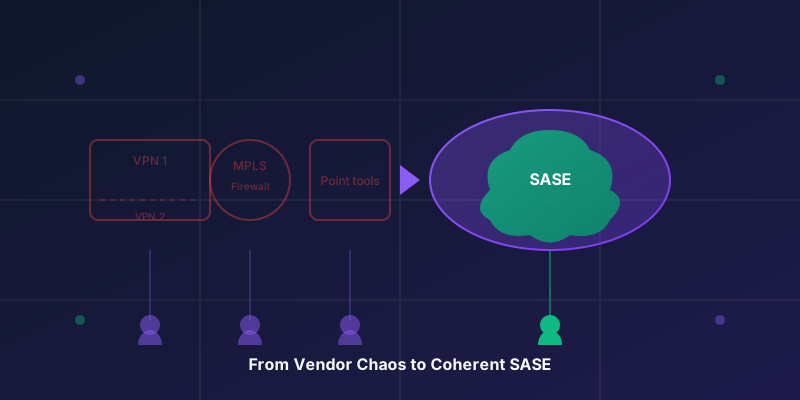
Many mid-market companies sit on a fragile patchwork of VPNs, MPLS links, firewalls, and point security products that barely keep up with hybrid work. Meanwhile, the market is racing toward Secure Access Service Edge (SASE) as the default way to converge networking and security in the cloud.
Turning that vendor chaos into a coherent SASE journey is not just a technical upgrade — it is a strategic move that impacts cost, risk, and your ability to support growth through 2026.
Why SASE is on every CIO’s agenda
SASE combines network and security capabilities (like SD-WAN, secure web gateway, ZTNA, CASB) into a unified, cloud-delivered service. For mid-market leaders, three forces make this urgent:
- Hybrid and remote workforces demand secure, performant access from anywhere.
- SaaS and public cloud usage keep growing, making old “castle and moat” networks irrelevant.
- Budgets are tight, so running parallel stacks of MPLS, VPN, and security boxes is unsustainable.
Analyst firms expect SASE adoption to accelerate significantly through 2027, with a strong shift toward single-vendor or tightly integrated dual-vendor platforms.
Recognizing vendor chaos in your own environment
Before designing a roadmap, acknowledge the current state. Typical signals of vendor chaos:
- Multiple VPN gateways with different clients and policies across regions.
- MPLS contracts for branch connectivity plus separate SD-WAN pilots.
- Separate appliances or subscriptions for URL filtering, DLP, remote access, and CASB.
- Overlapping invoices from 5–10 vendors with no clear ownership or accountability.
Why this hurts the business
- Poor user experience: remote workers juggling multiple VPNs and seeing inconsistent performance.
- Slow change: adding a branch, app, or region takes weeks because networking and security are separate projects.
- Hidden risk: no single view of who has access to what, from where, and under which policy.
| Dimension | Vendor chaos today | Coherent SASE target |
|---|---|---|
| User experience | Multiple VPNs, inconsistent performance | One access model, optimized per location |
| Security policy | Fragmented rules across tools | Central policy, consistent everywhere |
| Cost structure | Capex hardware + overlapping licenses | Predictable subscriptions, simplified stack |
| Time-to-change | Weeks/months per change | Days or hours via centralized configuration |
Building a strategic SASE vision
A coherent SASE strategy starts from business goals, not from a feature checklist. Typical goals for mid-market leaders:
- Enable secure hybrid work without user friction.
- Reduce risk of data loss and ransomware by better visibility and control.
- Simplify the network and security stack to free up IT capacity.
- Align costs with usage (paying for what is actually consumed).
Key strategic questions
- What are the top 3 critical business services that must be “always on” and secure?
- Where are your users physically, and how will that change over the next 3–5 years?
- How many legacy data centers will you maintain, and for how long?
- What regulatory obligations (e.g., GDPR, sector-specific rules) shape your choices?
Answering these questions frames SASE as a business enabler rather than a buzzword project.
Single-vendor vs dual-vendor SASE
Market guidance converges around two realistic options: single-vendor SASE or a closely integrated dual-vendor approach.
- Single-vendor: One provider delivers both SD-WAN and cloud security stack.
- Dual-vendor: One for networking (SD-WAN), one for security services, tightly integrated.
Strategic trade-offs
| Option | Pros | Cons |
|---|---|---|
| Single-vendor | Simpler contracts, unified roadmap, one console | Vendor lock-in, less flexibility in some regions |
| Dual-vendor | Best-of-breed in each domain | More integration work, split accountability |
Analyst data suggests growing preference for single-vendor SASE platforms, especially as capabilities mature and mid-market customers want simplicity.
A pragmatic 4-phase SASE roadmap
Instead of a “big bang” cutover, mid-market leaders can structure SASE adoption in four phases.
Phase 1 – Assess and rationalize
Objectives:
- Inventory sites, users, apps, and existing security tools.
- Map network paths (how users reach apps) and identify bottlenecks.
- Identify contracts and renewal dates for MPLS and security tools.
Deliverables:
- Baseline cost and complexity picture.
- List of “quick wins” where SASE can improve user experience fastest.
Phase 2 – Choose strategic partners
Objectives:
- Shortlist 2–3 SASE candidates based on coverage, features, and support.
- Run a targeted pilot (2–3 sites + a subset of remote users).
Selection criteria:
- Cloud coverage and PoPs close to your user base.
- Integrated security functions (ZTNA, SWG, CASB, DLP) with clear roadmap.
- Managed service options if your team cannot operate SASE 24/7 alone.
Phase 3 – Migrate branches and remote users
Objectives:
- Replace MPLS and legacy VPN use cases with SASE gradually.
- Prioritize high-value branches and heavy remote user groups.
Success metrics:
- Reduced mean time to access new SaaS apps.
- Improved user satisfaction with performance.
- Reduced operational incidents for remote connectivity.
Phase 4 – Optimize and innovate
Objectives:
- Use SASE analytics to refine policies (e.g., identify risky apps, shadow IT).
- Integrate SASE insights into broader risk management and SOC workflows.
Outcomes:
- Continuous improvement of security posture.
- Data-driven decisions about retiring legacy tools.
Managing internal resistance
SASE transformation touches infrastructure, security, and end-users. Expect resistance.
Typical concerns
- Network teams worry about losing control to “cloud black boxes”.
- Security teams fear gaps during migration.
- Finance is wary of “yet another big subscription”.
Strategies to handle this:
- Frame SASE as a consolidation and simplification initiative, not just new spend.
- Bring network and security teams into the vendor evaluation and pilot process.
- Show early wins through pilot metrics (e.g., fewer tickets, higher uptime).
| Stakeholder | Concern | Talking point |
|---|---|---|
| Network | Loss of control | Central visibility, policy-driven routing |
| Security | New attack surface | Unified inspection, improved identity controls |
| Finance | Cost of change | Tool consolidation, MPLS savings, predictable opex |
| End-user | New client, changes to access | Better performance, simpler “one way” to connect |
Quantifying business impact
Executives back what they can measure. SASE projects should be tied to clear KPIs:
- Cost: Reduction in MPLS spend, hardware refresh costs, and overlapping licenses.
- Risk: Fewer security incidents linked to remote access or misconfigured VPNs.
- Productivity: Time savings for users and IT when joining, moving, or changing roles.
An example high-level business case:
- 20–30% reduction in total WAN and security connectivity spend over 3–5 years via consolidation and MPLS reduction.
- 30–50% improvement in time-to-deploy new sites or SaaS apps due to centralized configuration.
- Better auditability and compliance reporting through unified logs and policies.
Basic automation pattern: on-boarding a new site
Even without deep coding, a simple infrastructure-as-code pattern can help standardize new site deployments with SASE:
module "branch_site_berlin" {
  source        = "./modules/sase_branch"
  site_name     = "Berlin HQ"
  country       = "DE"
  internet_link = "1G"
  user_count    = 250

  apps = [
    "m365",
    "salesforce",
    "custom-crm",
  ]

  security_policy = "standard-eu-office"
}
Whether implemented in Terraform or a vendor-specific template, the idea is:
- Each site is declared with consistent parameters.
- SASE policies and routing are applied programmatically, not manually per branch.
Looking ahead to 2026
SASE is evolving quickly. Trends that matter for mid-market leaders include:
- Increasing adoption of single-vendor, fully cloud-delivered SASE platforms.
- More managed SASE offerings tailored to mid-market customers with limited in-house expertise.
- Deeper integration of AI and analytics for proactive threat detection and performance tuning.
Leaders who start now with a clear roadmap, governance model, and realistic pilots will be in a strong position by 2026: a simpler architecture, better user experience, and a security posture aligned with the way business actually operates.