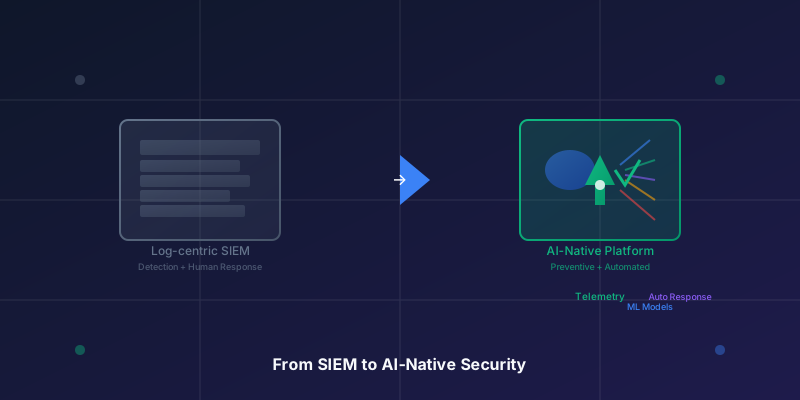
Security products are undergoing a major shift: from passive log collectors that wait for human analysts to react, to AI-native engines that predict, prevent, and adapt at machine speed.
Designing platforms for this new reality means rethinking data pipelines, feedback loops, and product decisions — not just bolting models onto an old SIEM.
From log-centric SIEM to AI-native defense
Traditional SIEMs were built around:
- Centralized log aggregation.
- Rule-based correlations.
- Human-driven investigations with dashboards and alerts.
In an environment where attackers use automation and AI to move faster, that model hits its limits: data volume explodes, rules can’t keep up, and human attention is scarce.
What “AI-native” actually means
AI-native security platforms:
- Treat telemetry (identity, network, endpoint, cloud, app, and AI agent activity) as a continuous signal, not just logs.
- Embed machine learning and analytics into the core decision loop, not only as an add-on feature.
- Close the loop with automated responses and product UX built around risk-based decisions.
| Aspect | Log-centric SIEM | AI-native security platform |
|---|---|---|
| Data | Logs and events | Rich telemetry streams and context |
| Analytics | Rules, basic correlations | ML models, anomaly detection, behavior analytics |
| Response | Human-driven playbooks | Automated or semi-automated responses |
| Focus | Detection & compliance | Prevention, prediction, resilience |
The architectural implication: you are building a data platform first, then a security product on top of it.
Telemetry as a first-class product concern
AI models are only as good as the telemetry they receive. Designing an AI-native platform starts with:
- A consistent event schema across sources (identity, network, endpoint, SaaS, cloud, AI agents).
- Low-latency ingestion pipelines capable of handling high volume and variability.
- Data quality policies (deduplication, enrichment, normalization).
Key telemetry domains
- Identity and access: authentication, authorization decisions, privilege changes.
- Network and SASE: traffic flows, policy hits, egress patterns.
- Endpoint and workloads: process creation, file operations, container activity.
- Cloud and SaaS: API calls, configuration changes, resource creations and deletions.
- AI agents and models: prompts, tool invocations, data accesses, model responses.
Telemtry unification enables cross-domain detection (e.g., suspicious identity behavior correlated with unusual data exfiltration patterns).
Architecture building blocks
Designing an AI-native security platform typically involves:
- Ingestion layer: collectors, agents, APIs, and connectors feeding telemetry into a central pipeline.
- Stream processing: real-time normalization, enrichment, and feature construction.
- Feature store: online (real-time) and offline (batch) features for models.
- Model serving layer: scoring pipelines for anomaly detection, threat classification, risk scoring.
- Decision engine: combines model outputs with policy and context to drive responses.
- Action layer: integrations to block, isolate, notify, or orchestrate workflows.
This is a loop, not a line: outcomes (e.g., “true positive incident”, “false positive”) flow back as labels.
Feedback loops and continuous learning
Without feedback, AI models drift and lose trust. AI-native security platforms must build:
- Analyst feedback loops: analysts mark alerts as true/false positives, enrich incidents with labels.
- User and tenant feedback: customers adjust sensitivity, suppression rules, and response automation levels.
- Automatic labeling: events like password reset, blocklist addition, or ticket resolution are used to refine patterns.
Example learning loop
- Models flag abnormal behavior for an identity (e.g., unusual login locations and resource access patterns).
- The decision engine triggers a “step-up auth + notify security team” response.
- Analyst investigates and marks the incident as malicious or benign.
- The system uses this label to update both per-tenant baselines and global models.
| Feedback source | Example signal | Usage in platform |
|---|---|---|
| Analyst | True/false positive, root cause | Model retraining, rule adjustments |
| Customer | Tuned policy thresholds | Tenant-level model calibration |
| System | Outcome of responses (blocked, allowed) | Closed-loop validation, auto-labeling |
The competitive edge comes from designing these loops as product features, not afterthoughts.
Product design decisions that matter
Beyond technical architecture, several product decisions strongly influence effectiveness:
- Multi-tenancy: how to share models and baselines across tenants while isolating data.
- Explainability: how to make model decisions understandable to analysts and auditors.
- Control vs automation: giving customers graduated levels of automated response.
- Integration surface: APIs, webhooks, and UI components for embedding detection and protection into customers’ existing tools.
Levels of automation
- Level 0: Notify only — AI suggests, humans decide.
- Level 1: Semi-automatic — AI suggests actions, humans approve in one click.
- Level 2: Full automatic in low-risk domains (e.g., block known bad IPs).
- Level 3: AI-driven prevention in high-criticality paths with strong guardrails.
| Level | Benefits | Risks/limitations |
|---|---|---|
| 0 | No unexpected actions | Slow response, analyst overload |
| 1 | Faster decisions, human oversight | Still limited by human availability |
| 2 | Quick wins in clear scenarios | Misconfiguration can cause minor disruptions |
| 3 | Maximum speed and coverage | Requires mature models and robust safeguards |
An AI-native platform usually supports all levels but encourages customers to progress as confidence grows.
Example: identity risk engine for preventive defense
Identity is a prime candidate for AI-native defense: the number of human and non-human identities is exploding, and identity is often the path attackers use.
An identity risk engine might:
- Compute a risk score per identity based on behavioral deviations and threat intelligence.
- Feed that score into access decisions (e.g., block high-risk actions, require step-up auth).
- Adapt per tenant and per identity type (user vs service vs AI agent).
Conceptual scoring snippet
def compute_identity_risk(identity_id, events, threat_intel):
  features = build_features(events, threat_intel)
  base_score = model.predict_proba(features)["malicious"]
  adjustments = 0.0

  if features["new_country_login"]:
      adjustments += 0.15
  if features["sensitive_resource_access"]:
      adjustments += 0.10
  if features["known_fraud_indicator"]:
      adjustments += 0.25

  return min(1.0, base_score + adjustments)
The resulting risk score flows into the decision engine:
- Low risk: allowed, maybe with passive monitoring.
- Medium risk: step-up auth, extra logging.
- High risk: block access, alert security team, rotate credentials.
Ensuring resilience and compliance
AI-native platforms must operate under regulatory and operational constraints:
- Data residency: where telemetry and model outputs are stored and processed.
- Privacy: minimizing collection of personal data and applying pseudonymization/anonymization.
- Auditability: ability to explain why a particular action was taken or blocked.
Resilience patterns include:
- Multi-region architecture for core services.
- Graceful degradation when AI components fail (fallback to rules, safe defaults).
- Rate limits and circuit breakers for automated responses to avoid cascading failures.
Opportunities and challenges toward 2026
Trends shaping AI-native security platforms through 2026:
- Preemptive cybersecurity and AI-driven predictive threat intelligence are moving from vision to mainstream expectations.
- AI security platforms (AISPs) are emerging as unified frameworks to protect both traditional systems and AI pipelines.
- Identity-centric, AI-driven defense is becoming a central pillar, focusing on both human and non-human identities.
Challenges include:
- Talent: teams must blend data engineering, ML, and security expertise.
- Trust: customers need confidence that models are accurate and won’t disrupt operations.
- Governance: regulators are starting to demand controls around AI security tooling itself.
AI-native security is not simply “add a model to your SIEM”. It is a product and architecture re-platforming around telemetry, feedback, and automated decision-making — with human analysts in the loop where they create the most leverage.