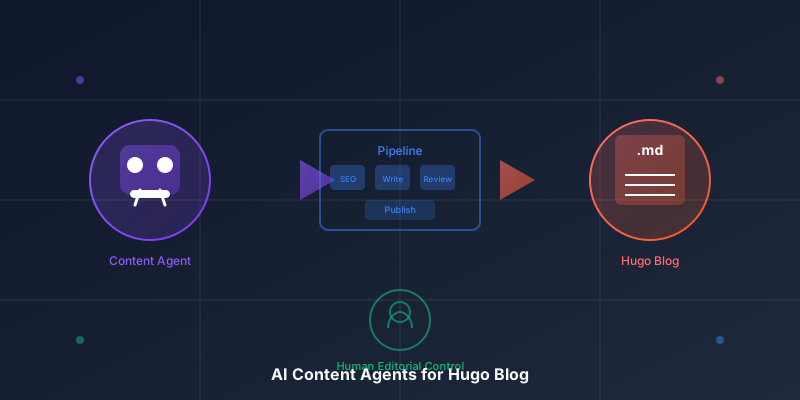
Technical blogs win when they publish consistently good content for the right audience — but human authors have limited time. AI content agents can turn a single editor into a small newsroom, ideating, researching, drafting, and distributing posts across channels.
The key is not “let the AI write everything”, but building workflows and guardrails that turn agents into reliable teammates rather than hallucination machines.
Why content agents now?
Three shifts make 2024–2026 a sweet spot for AI-assisted content:
- Foundation models understand technical topics well enough to draft real, useful articles.
- Agent frameworks can orchestrate research, SEO checks, and structured outputs across tools.
- Static site generators like Hugo slot neatly into automated pipelines (git-based, file-oriented).
For a tech blog, this means:
- More topic coverage without burning out the team.
- Faster reaction to market changes and product releases.
- Experiments with new formats (deep dives, case studies, explainers) with minimal overhead.
Defining your content agent team
Think in terms of roles, not monolithic “one AI”. A minimal “content team” of agents:
- Strategist agent: generates topic ideas aligned with your positioning and audience.
- SEO/research agent: validates search demand, competition, and outlines.
- Writer agent: turns outlines into full Hugo-ready Markdown.
- Distribution agent: repackages posts for LinkedIn, X, newsletters, etc.
Human roles that stay central
- Editorial director: sets themes, approves outlines, and gives final go/no-go on drafts.
- Subject-matter experts: provide seed ideas, review technical details, and correct drafts.
- DevOps/content ops: maintain the pipeline integrating Hugo, CI, and publishing channels.
| Role | Human responsibility | Agent responsibility |
|---|---|---|
| Strategy | Themes, voice, priorities | Suggest angles and series within constraints |
| Topic & SEO research | Approve directions | Gather keywords, SERP snapshots, outline drafts |
| Writing | Final review, nuance, personal stories | Draft structured posts in Markdown |
| Publishing & distribution | Approve scheduling | Generate social snippets, PRs, cross-posting |
The design goal: humans decide what and why; agents handle most of the how and first draft.
Workflow architecture for a Hugo-based blog
Hugo works with Markdown files and front matter, which is ideal for agents that produce structured text. A typical pipeline:
- Topic proposal (strategist agent + human approval).
- SEO + outline (SEO agent).
- Draft generation (writer agent, given JSON of metadata + outline).
- Review and edit (human).
- Merge to git + preview (CI).
- Distribution snippets (distribution agent).
Data model for posts
Define a simple schema your agents understand:
titledescriptionauthor(Florian, Sven, or Surrie)tagsproductstarget_length(e.g., 1500–2000 words)include_code_examples(true/false)
This schema becomes the contract between agents and your CI/CD system.
Guardrails for high-quality drafts
To keep AI agents from drifting, define guardrails in the prompts and pipeline:
- Fixed front matter structure (title, description, tags, author, etc.).
- Required sections (intro, core concepts, analysis, practical implications, conclusion).
- At least one Markdown table per post for comparisons.
- Explicit constraints: avoid fluff, cite tools or standards where relevant, maintain technical accuracy.
Example: writer agent prompt skeleton
system: |
  You are a senior technical writer generating Hugo-compatible Markdown posts.
  Follow the front matter schema and write for experienced engineers/leaders.
user: |
  Write a blog post with this metadata:
  - title: "{{title}}"
  - description: "{{description}}"
  - author: "{{author}}"
  - tags: {{tags}}
  - products: {{products}}
  - target_length: {{target_length}} words
  - include_code_examples: {{include_code_examples}}

  Use this outline:
  {{outline}}

  Requirements:
  - Valid YAML front matter at top.
  - Use headings, bullet lists, and at least one Markdown table.
  - Only include code blocks if include_code_examples is true.
  - Keep tone consistent with the author persona.
The important pattern: the prompt encodes your blog’s “style guide” so every draft starts close to your standards.
Example: simple SEO + outline workflow
A lightweight pipeline for SEO + outline:
- Strategist agent generates 10 topic ideas for the next month.
- SEO agent scores each idea on search demand and difficulty.
- Human selects 3–5 topics with best strategic fit.
- SEO agent creates detailed outlines with target keywords per section.
This can be implemented with a single model plus tools for accessing keyword APIs and SERP snapshots, or via manual research baked into the agent’s reasoning.
Outline quality checklist
- Clear H2/H3 hierarchy.
- 3–5 main sections, each tied to specific sub-questions.
- Keywords naturally mapped to sections (no keyword stuffing).
- Space for examples, code snippets, or diagrams where relevant.
| Aspect | Weak outline | Strong outline |
|---|---|---|
| Structure | Flat list of bullet points | H2/H3 hierarchy guiding narrative flow |
| SEO | Keywords dumped in random sections | Keywords aligned with intent per section |
| Depth | Vague “discuss X” | Specific questions and examples to address |
| Editorial fit | Generic tech trends | Directly tied to your product/audience positioning |
Integrating with Hugo and git
Once drafts exist, automation can carry them to production:
- Agents write
.mdfiles into a branch (or output them via API to your orchestrator). - A script (or CI job) validates front matter and structure (linting).
- Preview builds run automatically, giving editors a URL to review.
- After approval, merging triggers production deployment.
Example: simple generation + commit script
TOPICS_JSON=topics.json

# 1) Call LLM/agent orchestrator to generate posts for topics
curl -X POST https://your-agent-api/generate-posts \
  -d @"$TOPICS_JSON" > generated_posts/

# 2) Run validation/linting
python scripts/validate_posts.py generated_posts/

# 3) Commit to git
git add content/blog/*.md
git commit -m "Add auto-generated posts for $(date +%F)"
git push origin content-auto
From there, CI builds previews and your team merges to main after review.
Maintaining human editorial control
AI content agents are powerful but must operate under human supervision.
Key practices:
- Editorial calendar: humans define themes and community needs; agents fill the slots.
- Review thresholds: e.g., no post goes live without at least one human reviewer.
- Feedback loops: editors score drafts for accuracy and usefulness; these scores are fed back into agent prompts or fine-tuning efforts.
Governance decisions
- What types of posts can agents write alone (e.g., “round-ups”, basic explainers)?
- Which posts always require deep SME involvement (e.g., novel research, security advisories)?
- How do you disclose AI involvement, if at all, to your audience and regulators?
| Level | Description | Use cases |
|---|---|---|
| Assistive | AI suggests titles, intros, or edits | Human-led posts |
| Co-writing | AI drafts sections, human reorganizes | Explainers, tutorials |
| Agent-led | AI drafts entire posts, human reviews | SEO articles, pattern explainers |
Most teams find a mix of these levels appropriate depending on topic criticality.
Multi-channel distribution with agents
Once a post is merged, a distribution agent can:
- Generate LinkedIn post variants (short summary, quote, call-to-action).
- Produce X threads highlighting key insights.
- Draft newsletter intros pointing to the post.
- Suggest repost schedules and timing based on audience time zones.
Example: distribution agent prompt snippet
{
  "post_url": "https://example.com/blog/zero-trust-by-design",
  "post_summary": "{{short_summary}}",
  "audience": "security leaders and senior engineers",
  "channels": ["linkedin", "x", "newsletter"],
  "tone": "professional, insightful"
}
The agent returns channel-specific snippets, which your marketing team can tweak and schedule.
Measuring impact and improving the system
To keep agents accountable, track:
- Output volume (posts per month).
- Time per post from idea to publish.
- Editor time spent per draft vs fully human-written posts.
- Engagement metrics (click-through, time on page, shares).
Use these metrics to tune:
- Topic selection (which series resonate).
- Depth and complexity of drafts (are they too shallow, too dense?).
- Balance of human vs agent time across the workflow.
Future outlook: content agents as part of your product
By 2026, AI agents will not just help with content — they will be part of how your company operates and communicates. For a tech company:
- Docs, blog, and internal knowledge bases will share agent-assisted pipelines.
- Product UIs may integrate “explain this feature” content generated from the same system.
- Community Q&A and support articles can be seeded from blog content and vice versa.
Treat your AI content agents as a strategic capability: a system that continuously turns your expertise, product evolution, and market insight into compounding, searchable, and shareable assets.